The Rowallan
Manuscript
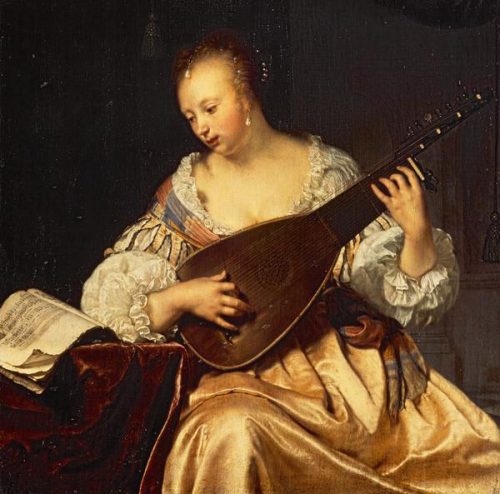
The Rowallan Manuscript is the oldest surviving collection of Scottish lute music in existence. Dating from 1612 – although quite possibly earlier – to approximately 1628, it was discovered in the ancestral home (a castle on the banks of Carmel Water in Ayshire), of Sir William Mure of Rowallan, which gives the manuscript its name.
INFLUENCES
Mure himself was a poet and a politician and a great supporter of the arts, not surprisingly therefore, the manuscript reflects somewhat, the changes that were taking place in Scotland, not just musically but also politically.
Compiled just a short time after The Union of Crowns in 1603, when James VI of Scotland (following the death of his cousin Queen Elizabeth I of England), became King James I of Great Britain. This Union of England, Ireland, and Scotland – hailed by some in Scotland, but bemoaned by most – effectively meant the dissolving of the Scottish Monarchy.
Although still known as a Kingdom, Scotland became little more than a puppet of England, which needless to say, caused great upset amongst the fiercely patriotic Scots. In addition, when departing Edinburgh Castle for his new home at Windsor Castle, the once popular King vowed he would return often to his beloved Scotland, but returned only once, some 14 years later!
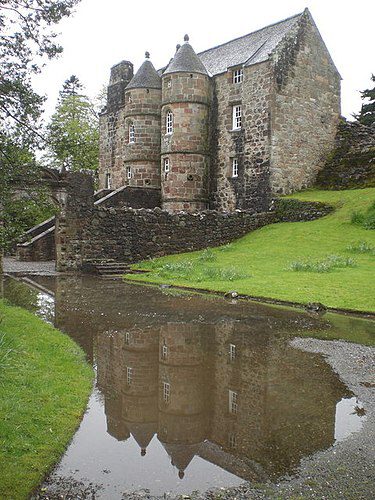
Rowallan Castle, Ayrshire, Scotland
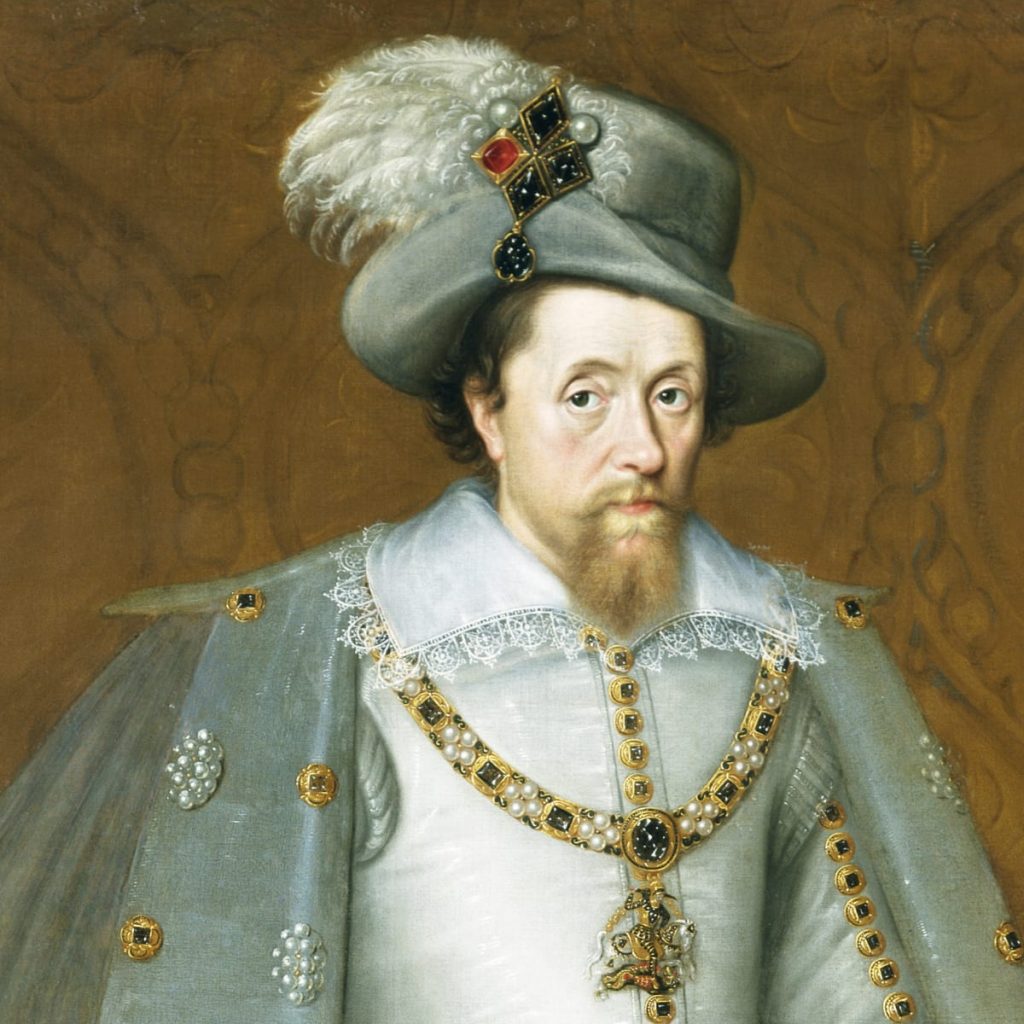
James VI of Scotland and James I of Great Britain
With this change in politics also came a change in music. Scottish lute music, was heavily influenced by the Royal Court, but when James VI, left for England, lutenists, began to embrace native folk music. Thus, The Rowallan Manuscript, interestingly has both – the influence of the Royal Court and the freedom and simplicity of folk music. In fact, it has a third influence – the Kingdom of France.
For Centuries, Scotland was influenced by what was taking place in Europe, and in particular, France. This was due to The Auld Alliance, established in 1295, which was an ancient pact between the two nations to counteract the power of England. Scotland and France shared royal, religious, military, financial, and trade links, as well as artistic and cultural ties. The Scottish arts and music, were all influenced by the French, and many artists and musicians, as well as the sons and daughters of the wealthy upper classes, travelled to France to study.

The Music
Thus, the Rowallan Manuscript contains both Scottish lute pieces, as well as French. It features many dance tunes which are decidedly French, and a number of delightful, lilting melodies, so typically Scottish, as well as some hauntingly beautiful pieces, conjuring up images of the mist shrouded Scottish highlands, and times gone by.
I came across the Scottish repertoire whilst studying the lute music of the Renaissance. Scottish music was heavily influenced by the Celts and was entirely unique, completely different from the Renaissance music being created throughout nearby England and Europe. The melodies are deceptively simple, yet took months to master. These pieces were composed between 400 and 500 years ago, when musical notation was in its infancy, and like all Renaissance music, contain no time signatures, and no indication of accents etc.
The modern day version of the Rowallan Manuscript is due to the work of Wayne Cripps, a man responsible for transcribing so much early music, for which musicians such as I, will be forever grateful. However, given the state of the original text (water damaged, faded and incredibly messy!), with numerous errors and ambiguities, much has been left to the imagination of the modern musician, and in many cases, the interpretation leaves much to be desired! Cripps suggests there were at least two scribes – Anna Hay and Sir William Mure – both with quite distinctive styles, with Mure crossing out many sections of Anna’s work. Anna’s sister Mary, also seems to have contributed to the text, but possibly with only titles and headings. So the task of transcribing this music was indeed a difficult one.
Cripp also suggests the original music was probably performed on a 9 course lute, although most pieces can be played on either a 7 or 8 course lute. I chose to play it on my 8 course lute, but recognise the deeper notes one could employ if playing a 9 or 10 course lute. To compensate, when playing an 8 course, the lowest course is tuned to C.
The dance tunes invite people to tap their toes and join in the dance, while other pieces seem to call the listener from far across the glens, drawing them back through time, allowing them to hear music from another century entirely.